15 Minutes: Pedigree Perfection
A Primer for the Pedigree Enthusiast
Michael Brown was on a leisure drive with his dad Michael, and Chinney, a Siberian Husky, when he came across a dog show. Since that introduction to the sport of pedigree dog exhibitions, Brown has bred Chow Chows and competes in 70 shows per year. From his home in historic Lambertville, New Jersey he unleashed the dogs for 15 minutes to offer this primer to assist your pedigree pursuits.
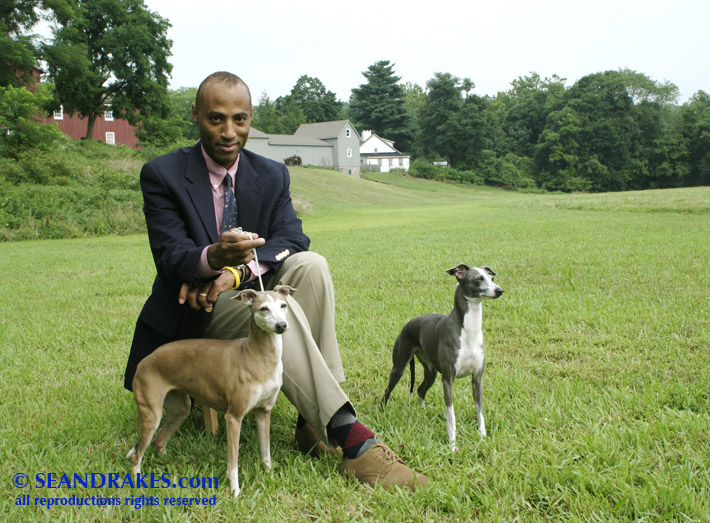
Michael Brown with Trudy and Shirley.
BREED RESEARCH. Investigating genealogy is a matter of priority for pedigree breeders. Before acquiring Marchwind Miro’ de Ca’nquet, a six-month-old Italian Greyhound, Brown says, “I went back ten generations looking at photographs of Miro’s ancestors…reading what owners had to say.” Brown’s ideal breed type had to have correct size and silhouette, a hound-like head and high-stepping strut. Dog World newspaper, specialty books and breed-specific Websites and kennels were instrumental to Brown’s research. Visiting major kennels (including some in England) to learn the types of dogs they produce informed his analysis. When creating your own kennel type you should be firm on how inbred or outbred you want to be—by adhering to either a small or broad gene pool. “You can have a successful breeding kennel with two or three very good brood bitches,” adds Brown, who never buys dogs for breeding from pet shops.
SOCIAL TRAINING. “First thing I do in preparing a dog for show is to get it a complete veterinary physical.” This screens the dog for parasites that provoke weight loss, and coat and skin deficiencies. Next, Brown sources a handling class at a respected kennel club to familiarize the dog with being around other dogs and humans. “These classes are the best simulation of real dog show conditions.” He and Champion Tudors Diamonds Are Forever (call name Shirley), a five-year-old high-strung Italian Greyhound, attended two 30-minute sessions per week for four months. “I worked to socialize her, I took her wherever I went [and] I made sure to expose her to children, the elderly and people in wheelchairs, so that no social encounter would faze her.” Weekly coat conditioning and teeth cleaning were coupled with networking with handlers at shows, and practicing

Michael with Emma.
postures and walking patterns required in the show ring. Brown recommends budding handlers join the Owner Handler Association of America , as well as a club for their specific breed.
SHOWTIME. When the AKC/Eukanuba National Championship awarded $50,000 and a 2004 Suzuki XL-7 for the owner of the Best in Show winning dog, and a $20,000 purse for best dog shown by its owner/breeder, debate flared, says Brown, “insiders felt that dog showing should remain an amateur status sport.” “No award money is given at prestigious shows like the Westminster Kennel Club Dog Show in New York or Crufts in Birmingham, England,” which attracts 20,000 dogs for its three-day extravaganza. “No one does this for the money,” said Eugene Blake, a revered handler and prominent African American show judge with over 50 years experience. Blake judges sporting, hound, toy and non-sporting categories and emphasizes that “we judge on breed type…without that you don’t have a [potential champion] what makes the dog breed is the way they move not the way they look.” Blake believes the sport is very accepting, “I’ve been involved since before the civil rights movement when places were segregated.”
At annual National Specialty, prizes for competitors who win points toward championship ranking range from $25 – $125. That’s nibbles ‘n bits compared to the princely penny enthusiasts invest. Brown incurred a $6,000 vet bill for orthopedic surgery on Shirley’s broken leg, show entry fees range $22 – $50, and buying a healthy Italian Greyhound pup can cost $1,300, while a show quality pup can fetch $4,000. Cultivate your curiosity, visit the American Kennel Club a comprehensive information emporium.
© SEAN DRAKES
Previously published.
[ 404.654.0859 | seandrakesphoto@gmail.com ]
Short Stay: Jo’burg Rising
South African capital grows
as business tourism attraction
My first mission upon landing in Johannesburg was to find a perch from which to soak in a South African sunrise. Equally warm greetings showed up all along my itinerary which was packed with mild adventures of dining on stewed ostrich, trailing springbok in the wild, and visiting historical sites. There is a glow around Jo’burg, as it’s fondly called. The city feels like a phoenix rising from an ominous spell. Dozens of cranes are weaving towers into the skyline, an underground subway is on a fast track to realization, and the country’s GDP growth rate hit 4.7% in the third-quarter of 2006. Confidence is strong and infectious.

Slice of Jo’burg.
South Africa’s profile as a destination for meetings, conventions and incentive travel is poised to soar. “The reasons for optimism,” offers Cameron Brandt, International Markets Editor for Emerging Portfolio Fund Research, “include the government’s conservative and  consistent economic policy, the rapid expansion of the Black middle-class, forecasts for 10% GDP growth in China [which has] positive implications for commodity demand, and planned public infrastructure spending tied to the [2010 FIFA] World Cup.” On the flip side, caution is encouraged because of “the expansion of household debt and lack of experience many of the new middle-class have when dealing with credit, still very high levels of unemployment, and the country’s large current account deficit.” Visit www.southafrica.info for more insight on doing business in South Africa. Travel is about the journey not just the destination. On our 15-hour intercontinental flight from Atlanta in Delta’s BusinessElite Class ($6,600-$7,900) the pampering began at the gate with VIP compliments in Delta’s Crown Room Club.

Blue Dot performs at Moyo.
On-board service deflects jet-lag and pleasures your senses with personalized five course gourmet dining and flavorful wines, all-leather luxury sleeper seating equipped with a state-of-the-art entertainment system, private video monitors, and a slew of comforts that make for a faultless five-star experience. Sandton, Jo’burg’s gleaming uptown district, bustles with Mercedes-Benz taxis shuttling folk to the Johannesburg Stock Exchange, Sandton International Convention Centre, restaurants in Nelson Mandela Square; among them is Lekgotla with its tribal chic  ambiance, and a massive mall with designer boutiques like Shakur Olla and Sun Goddess, all set near our hotel, the Michelangelo Towers. Italian heels and Swiss timepieces adorn guests who zip from tables at the lobby restaurant “8” to suites like my tech-savvy duplex ($715 per night). The ultra-swank Cupola suite has a 360-degree view of Jo’burg, private rooftop pool, butler and security staff and commands $5,700 per night for unrivalled luxury. Considered the ‘urban heart’ of South Africa, Johannesburg is set like an axle in the center of eight provinces: Cape Town, on the picturesque southwest coast, is famed for its lush winelands and whale watching, Cape Point, where the Indian and Atlantic oceans lock arms, and the historical site Robben Island. The North West province is home to the
 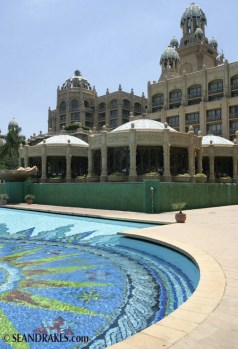 super-sized extravagance of Sun City which contains four hotels, that offer family attractions, casino gaming, two 18-hole par 72 golf courses and conference facilities. The ultimate safari adventure is in Mpumalanga in the northwest, where 10,000 elephants and prides of lions roam Kruger National Park. My guide, Joe Motsogi, owner of JMT Tours, charted a fulfilling excursion that included shopping at Chameleon Village and an exhilarating sunset safari drive. Seasons in South Africa are distinguished by precipitation rather than severe temperature changes. Rain or shine there are eventful attractions year-round: Durban July is an illustrious horse racing event steeped in aristocratic tradition; young and celebrated musicians rule the spotlight at the Standard Bank Joy of Jazz Festival; golf enthusiasts flock to majestic greens for the Million Dollar Golf Challenge and the Nelson Mandela Invitational Golf Challenge; and wine connoisseurs attend Winex to sample and shop for vintages from over 200 South African wineries.
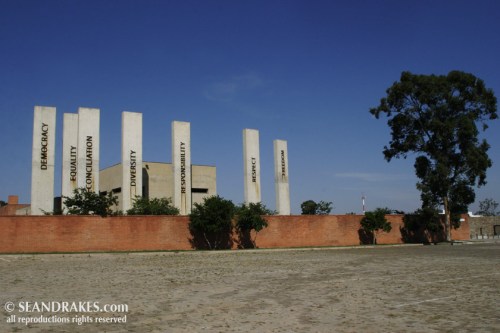
Apartheid Museum.
Near downtown Johannesburg is the Apartheid Museum, a sleek, modern structure that houses a comprehensive and riveting chronicle of South Africa’s journey to democracy. It also invokes optimism for South Africa, a country as a democracy that is only 13-years-old. It’s a new day. Contact South Africa Tourism to facilitate your convention, vacation and incentive travel needs.
© SEAN DRAKES
Previously published.
[ 404.654.0859 | seandrakesphoto@gmail.com ]
Courting Contractors
A first-time home remodel almost
becomes a costly nightmare
“Hands down I was sold on the house when I stepped onto the deck and saw the beautiful meadow and creek,” recalled Alvin Adell, M.D. “I was sold on the setting, the house itself needed some love.” For Adell, 46, an attending anesthesiologist, the appeal of his 3,200 square-foot Center Hall Colonial in Colts Neck, New Jersey includes being a 60-minute train ride from New York City and Atlantic City, and 35 minutes from Newark International Airport. “I travel often, convenient access was a major selling point.” In April 2000 Adell began financing the TLC his home needed. His remodel project had three priorities: create the feeling of a luxe spa on a homey scale in the master bath, build-out a secondary level for the master suite (with fireplace, walk-in-closets and patio), and modernize the kitchen with a heated flooring system and open floorplan onto the dining room and deck. “I love to grill,” shared Adell, “sometimes in the winter, so easy access to the deck is important.”
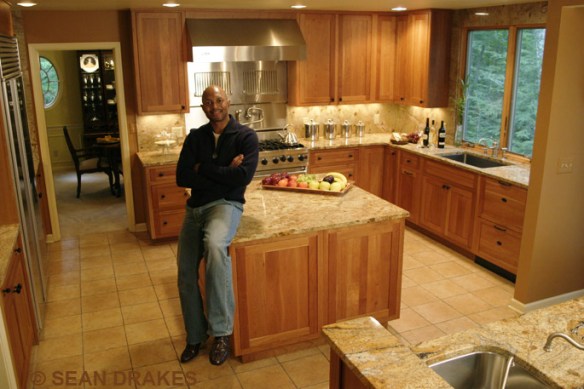
Dr. Alvin Adell’s remodeled and expanded kitchen, fitted with heated flooring and premium appliances, hosts many dinner parties and is the center attraction in his home.
“One of the best things was to work with an interior designer [Beau Boger] who knew where everything needed to go, [my] designer worked with the vision of existing furniture,” said Adell. “I went around with my interior designer to pick the materials together.” Adell considers his style to be traditional based with contemporary African and Asian accents.
Contractor selection. Through referrals Adell sourced three contractors to interview, he requested references and visited one site for each contractor screened. He “checked with the Better Business Bureau for outstanding complaints, and made a subjective assessment,” said Adell, “to see if I would be able to trust that person in my home when I’m not there.” “One contractor was low-balling, I visited hardware stores to gauge the price of materials and knew it was impossible to do the job with his bid, he was eliminated. Low-ballers eventually add costs or skimp.” Adell established an account at Route 18 Lumber so his contractor “didn’t have to [shell-out] upfront money on materials and have to wait to be reimbursed,” said Adell, “and I didn’t have to worry about him overcharging me for inferior materials. Invoices came directly to me and I qualified for acontractor’s price on materials.”
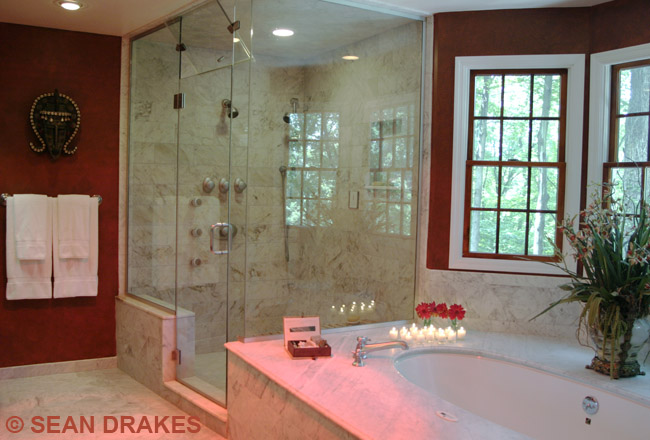
Master bath with spa comforts, including heated flooring, jacuzzi tub and multi-head shower, adds value.
Budget for surprises. Even with layers of pre-screening you may not be exempt from costly misjudgments. “Firing a contractor midway is one of the worst things you’ll have to worry about,” said Adell. “It delays [project completion], contractors hate to come behind another contractor midstream to correct work. In their mind, they know you’re vulnerable, so a $10,000 job could cost $50,000.” In Adell’s case, he waited till the “big hole in the back of my house was sealed” then consulted his attorney to be certain he would be clear and free to fire his contractor for ‘changing design decisions, hiring substandard subcontractors, shoddy workmanship, and for being grossly behind schedule,’ though the contract lacked a timeline stipulation. “I would find mistakes laid in concrete; [contractor removed] an oak hardwood floor that was never supposed to be replaced.” David Jaffe,

Master suite build-out with walk-in closets, fireplace and patio, positioned over the two-car garage.
staff VP legal affairs for the National Association of Home Builders, said, “a ‘time is of the essence’ clause elevates the value the homeowner places on time, the contract can be terminated on the grounds of breach if the timeline is missed [however this can be] negated [if another clause pardons contractor] for delay due to reasons beyond his control.” In hindsight, Adell said, “I would have found a contractor who has in-house plumbing, carpentry and electrical, which means if the general contractor actually employs those three craftspeople they have more control over their schedules, if the general contractor subs it out to individual contractors and the general contractor runs off schedule he’s at the mercy of the subcontractors.” A full-service contractor is generally more expensive. Research resources, project guidelines, and educational seminars are available through the National Association of Home Builders.
Adell credits his astuteness to a reading list comprised of Home Depot Home Improvement 1-2-3 (Meredith Books; $34.95), Reader’s Digest New Fix-It-Yourself Manual (Reader’s Digest Association; $35.00), and Architectural Digest. “Share your ideas with others,” said Adell, “you never know how their input might turn out to be a brilliant contribution.”
One year beyond his projected deadline, Adell’s investment tallied a conservative $200,000—more than $50,000 over budget. Recently, his property appraised at $1.2 million, which redeems the unsavory portion of his first home renovation.
© SEAN DRAKES
Previously published.
[ 404.654.0859 | seandrakesphoto@gmail.com ]
Related articles
Savvy Sailor
Frugal comrades discover how teamwork
can get you more boat for less money
Anchoring a boat for seven months adds up to a tidy sum of money down the drain, so Jerome Abernathy didn’t idle on the idea to enter a co-ownership arrangement for his second boat. At the 2001 Annapolis Boat Show, Abernathy, a hedge fund manager with Stonebrook Structured Products, and his friend Arnold Mintz, executive vice president of Asset Alliance Corporation, found a new Beneteau 473 worthy of their $300,000 investment. “Arnold used to own a sail boat, one day while sailing my old yacht we hatched the idea of buying a larger vessel together,” recalled Abernathy. “It is less expensive to own a larger boat in a partnership than to own a smaller one by yourself.” Abernathy’s first boat [“Noe”] was a Beneteau 36cc that swallowed $9,000 per year for maintenance, insurance, and dockage fees. In contrast, he drops $6,000 into “Victory” every six months.
 BEFORE YOU BUY. The type of waters and distances you intend to sail informs the type of boat you buy. “Sailboats are the original hybrid vehicles,” said Abernathy. “You have sails and (usually) a diesel engine for propulsion and electricity generation. When sailing you rely on a bank of batteries for electricity, often, a sailboat will have solar cells or a windmill to recharge its batteries. Sailboats are very stable, it is not unusual for a 25-foot sailboat to cross the ocean. Power boats, [however] rely solely on an engine for propulsion and usually are not stable enough for sailing open seas, and are much more expensive to operate.” Abernathy added, “to go cruising or to sea, you should consider a boat greater than 30-feet with a proper galley (kitchen) and head (bathroom).”
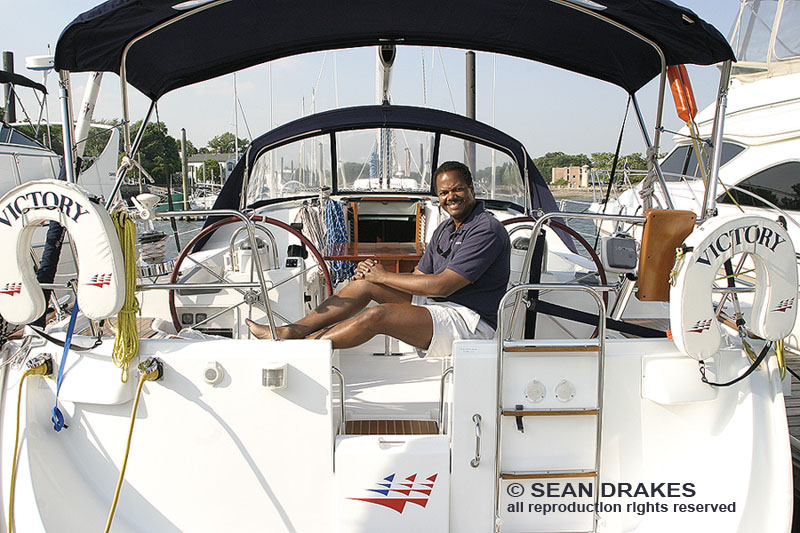
Jerome Abernathy on Victory in New York.
SAILOR 101. Abernathy has raced from Charleston, South Carolina to Bermuda and does monthly day-sails from his homeport in Mamaroneck, New York to Newport, Rhode Island and Essex, Connecticut. Before boarding to sail any distance it’s imperative to acquire sailor 101 knowledge. Although Abernathy and Mintz were seasoned sailors, he said, “our dealer spent many hours teaching us the boat’s systems.” “I highly recommend courses that follow the American Sailing Association’s curriculum [which teaches] basic sailing, navigation, weather forecasting, and emergency rescue procedures.” Abernathy advises, “Take an ASA Basic Keelboat course, join a local sailing club to gain experience on smaller boats like the J24, and volunteer to crew on a race boat return delivery.” He also advocates attending boat shows, vacationing on a chartered yacht with a group, and subscribing to Sail and Cruising World magazines and Practical Sailor newsletter. As you consider upgrading your boat, Abernathy suggests keeping current on “sailing techniques, technology changes and new equipment offerings.”
ADDED VALUE. Camaraderie and spending less time on upkeep are benefits of co-ownership to Abernathy who says having “compatible uses for the boat” was important in his decision, as was having a written agreement that clearly articulates the terms of the partnership. “A new boat will depreciate, but not as fast as cars,” said Abernathy, “and electronic systems such as radar and GPS will likely need maintenance early on.” After initial depreciation—depending on how well you maintain your craft, the manufacturer and model—a boat actually increases in value. According to Abernathy, “If your boat has a galley and head, your boat loan can qualify for second-home tax treatment, which considerably lowers the cost of ownership.” For even more savings, consider mooring your boat (tethering to an offshore anchor) for roughly $100 per month, compared to paying $300 – $690 to dock it.
© SEAN DRAKES
all reproduction rights reserved
Previously published.
[ 404.654.0859 | seandrakesphoto@gmail.com ]
Related articles
Inside the Fine Art Game
The market for fine art by African-Americans reached an exciting and pivotal moment in February 2007. Swann Auction Galleries in New York City, noted for vintage photographs, prints and drawings, hosted the first sale by a major auction house devoted exclusively to African-American fine art. Auction sales exceeded Swann’s predictions raking in $2.7 million, seventeen sales records were set, and participation was the largest seen by the auction house, with over 200 attendees. African-American fine art is being included in major museum exhibitions, documented and discussed, and has emerged as the most actively collected art in the marketplace. Wangechi Mutu, 39, maintains a waiting list of pre-screened buyers for her next works, and recently sold out before opening night. Investing in fine art is an enriching pursuit, this primer can help demystify the valuation process, develop your approach to collecting, and dispel the perception that collecting fine art is for the wealthy.
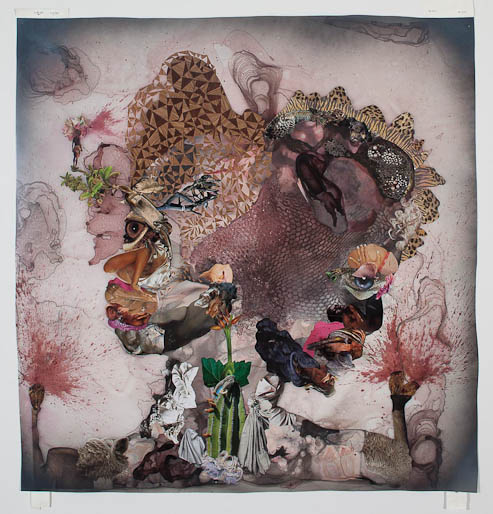
Before Punk Came Funk, 2010, mixed media ink, collage, by Wangenchi Mutu.
Growing awareness grows demand. “Black art speaks to the black experience and that is what sets it apart,” explains Eric Hanks, art instructor and owner of M. Hanks Gallery in Santa Monica, California. “The work has to have meaning that doesn’t have to be that deep. “Bearden [for instance] references his childhood in Pittsburgh and his grandparents who are black.” According to Hanks, 53, “the early part of the 20th century and the latter part of the 19th century are the eras collectors and museums clamor for” because there is no more of it being made and those works fill historic and aesthetic gaps in American art collections.
“Contemporary art today is about investigation, not accepting boundaries,” says Nigel Freeman, 39, director of Swann’s African-American fine art department. “Emma Thomas was the first African-American woman to have a retrospective at the Whitney Museum. She was [a retired teacher] in her 60s when she achieved great fame,” he says. “I had a 5”x8” paper piece that sold for $16,000, her large canvases command six figures. “Recently there has been growing awareness through touring museum shows; museums are active in elevating and acquiring works,” shares Freeman.”
Art in black and white. The Swann sale ignites a new dialogue that explores the implication that these artists’ works cannot stand on the same merit as their European counterparts. “[Auctions] put [the work] into the marketplace,” says Franklin Sirmans, curator at The Menil Collection in Houston, Texas, “but [the work] can’t be limited to only showing in a racial construct. What’s the point?! I don’t think any of those artists created the work for it to only be valued next to other black artists.” “Swann has taken a very bold and significant step that other auction houses have not,” opines appraiser and art adviser Halima Taha author of Collecting African American Fine Art: Works on Paper and Canvas (Verve Editions; $50.00).

Art appraiser and author Halima Taha at NBAF.
“Sotheby’s and Christies would traditionally include African-American artists, but sporadically. Not annually, not the same artist. So there would be sporadic values. Sales were lower than what the work was actually selling for, in that case auctions were doing a disservice.” Taha, 46, asserts, “It is extremely important that these artists be included in auctions because the auction is the international marketplace, it’s not a black marketplace, not a white marketplace, not an American marketplace, it’s international.”
Gallery owner Bill Hodges highlights another conundrum when he said a Norman Lewis abstract he has priced at $135,000 would sell for $10 million if it were by Jackson Pollock. While demand for African American fine art grows, prices are yet to catch an uptick momentum.

The Yellow Hat, oil on canvas, 1936, by Norman Lewis.
The off-the-record whisper from art aficionados is that an African-American artist with white representation stands to attain greater access and exposure, and command higher prices and fatter paychecks as a result. But Hanks insists, “talent, connections, luck, perseverance and a thick skin” are what artists need to be able to seize the coveted attention of the Whitney, MoMa and Guggenheim.
Fine art game. To seize an edge, seasoned collectors train an eye on portals for emerging talents such as the Kenkeleba Gallery and Museum of Contemporary Diasporan Arts in New York City, The Hammonds House Museum in Atlanta, The Southside Community Art Center in Chicago, as well as incubators such as the artist-in-residence program at The Studio Museum in Harlem. Understanding how an emerging artist is transformed to a celebrated voice may influence your approach to buying work by an aspiring talent. “It’s the collective activity of the artist, the dealers, the collectors, the curators, the critics and the auction houses. Their interaction with one another enables them to become the cultural and economic arbiters of taste, together that is what propels an artist into the marketplace,” explains Taha. “One by itself isn’t going to work. You need dealers to contact the critics and to have relationships with auction houses and major collectors. That’s the real art game. [There are] a lot of incredibly talented [artists] but they’re not interacting with curators who are part of that collective activity.” Collector Brenda Taggart Thompson remarks, “People miss [out on] some important art because [those works] are not supported by the game.”
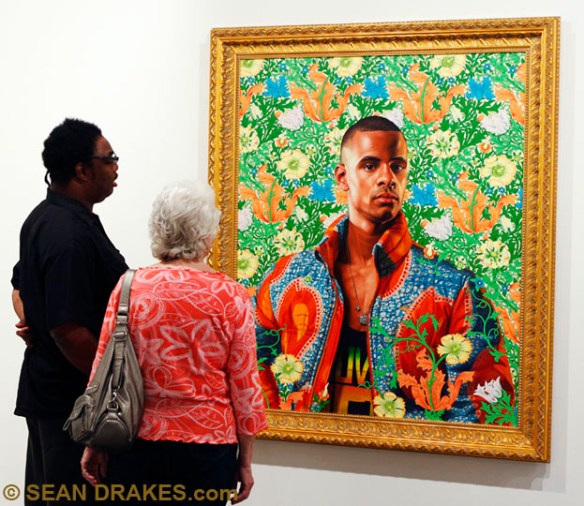
Morthyn Brito, 2011, oil on linen by Kehinde Wiley at Art Basel Miami 2011.
History affects value. A well-rounded collection gives a sense of the various approaches to a particular style. “Provenance (history of ownership) supports and can increase the value of a piece,” offers Hanks, an art adviser for distinguished actors, doctors and athletes, this document establishes authenticity and identifies previous owners, “if they are famous it will positively impact the value.” Recently Eldzier Cortor’s Portrait of a Woman, once owned by author Ralph Ellison, fetched $110,000 at auction, it was estimated to sell for $30,000.

You Do, 1993-1994, cut paper on canvas, by Kara Walker.
“When provenance doesn’t pan out and the work seems suspicious it makes the piece seem stolen or fabricated,” shares Hanks. Appraisers gather provenance but are not obligated to authenticate art. They are expected to check the Art Loss Registry and the FBI’s registry of stolen works. “The burden of duty is much greater on the person authenticating the piece than the appraiser.”
Get the right appraisal. Yolanda and Greg Head of Stone Mountain, Georgia, have been collecting African-American abstraction since 1999, “I have my collection insured,” offers Greg, 49. “I look at the value over time [by] looking at auctions and auction records. He also attends the art mart at The Fine Art Fair of the National Black Arts Festival in Atlanta to see what sold. “It gives me a sense of how my art has escalated; every three to four years I have it appraised.” Collectors must be clear about their use for an appraisal and disclose that to the appraiser, offers Taha. Appraisals can be for insurance against loss, inventory or tax benefit when donating art to museums. Researching the comparable economic analysis is the same for all appraisals, but the approach to mathematical calculations vary, hence, specifying intended use is essential. An appraiser’s fee schedule ranges $150—$500 per hour depending on their expertise and resources.
Collectors on collecting. Enthusiasts say ‘buy what you love’ because there is no fault-proof formula for what to buy and when to sell. Yet most everyone has a faithful strategy for collecting:
Former NBA player Elliot Perry, 38, of Memphis, Tennessee invested 11 years to grow his collection by contemporary and master artists, he investigates a dealer’s reputation and cultivates a relationship with dealers intent on “helping build a collection not just move inventory.” A good dealer “should have a feel for what you like.” Another attractive quality is “when a dealer is willing to lose a deal [by advising] you to go elsewhere because another gallery has a better quality piece.”

Rooftops on Wabash, 1938, oil on canvas, by Eldzier Cortor.
“There is a misnomer [that] collectors are plunking down thousands of dollars all at once,” shares Head, “galleries understand they have to ‘work with you,’ the code phrase for payment plan.” Head reads periodicals like Art in America and the International Review of African-American Art, and suggests shows like Art Basel, Art Off the Main, and Art Chicago to keep abreast of trends.
Brenda Taggart Thompson and husband Larry, of Greenwich, Connecticut, have collected since 1977. “Books help refine your eye to see beauty in lots of places,” says Brenda, “not just where some gallery has decided it is.” Thompson’s reference library contains African American Art and Artists by Samella Lewis (University of California Press; $70.00), St. James Guide to Black Artists by Schomburg Center for Research, Afro-American Artists: A Bio-bibliographical Directory by Theresa Cederholm, Two Centuries of Black American Art by David C. Driskell, and history books on American art and photography.
Knowing the history adds value to works and allows collectors to have cross-references when they work with art dealers. “Attending lectures, going to museums, listening to curators talk about how [shows] are put together,” says Thompson, “are instrumental to a collector’s growth.” Hanks adds, “look at art wherever it may be, your understanding will improve and your collection will reflect it.”
© SEAN DRAKES
Previously published, edited version in Black Enterprise.
[ 404.654.0859 | SEANDRAKESPHOTO@gmail.com ]
LA Confidential: Brad Johnson fuels a Downtown revival
An appetite for dining out is integral to life in Los Angeles. It’s pretty common for movie scripts and record deals to get the greenlight over a four-course meal. For restauranteur Brad Johnson, success in the fine dining sector of the food service industry affords prized access to the pulse of Hollywood.
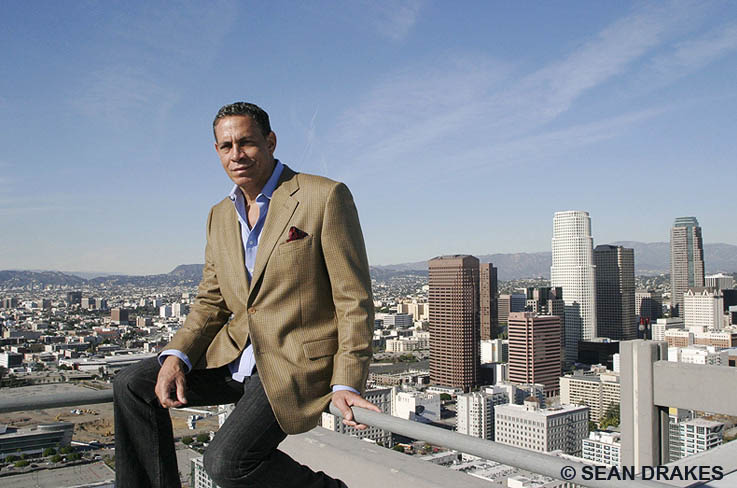
Brad Johnson atop Windows in Downtown Los Angeles.
Johnson, a native New Yorker, migrated west in 1989 and opened the Roxbury, an immensely popular restaurant and dance club that was immortalized in the movie “A Night at the Roxbury.” His follow-up contributions to LA’s nightlife, Georgia (co-owned by Denzel Washington) then The Sunset Room (both now closed), helped spark the revival of the Hollywood business district. These days his passion for dining is invested in Downtown Los Angeles where he manages an impressive net income turnaround for Windows restaurant, which is part of Earvin ‘Magic’ Johnson’s portfolio.

Table at Windows with a drop dead gorgeous view.
When Johnson entertains visitors he avoids the beaten-track. “I’ve taken friends to classes at Power Yoga, to dine along the Malibu coast, and to The Ivy or the Newsroom where you might find a fair number of [film] industry networkers.” “I love exploring Chinatown and The Farmer’s Market on Main St. in Santa Monica on Sundays,” adds Johnson, who frequents the nine-mile bike path that starts in Manhattan Beach and snakes along the vibrant Venice Beach boardwalk. Major boxing events and the uninhibited nightlife in Las Vegas provide an alternative weekend experience for Johnson who manages V Bar at The Venetian resort. “Jobs and people are always turning over so there’s a constant search for what the next thing is,” he says, “since people [in LA] define themselves by where they go and who they’re sitting next to it’s important to know what place that is at any given time.”
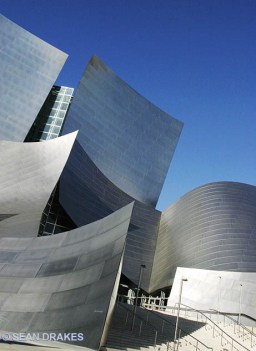
Walt Disney Concert Hall.
Restaurant sales in California in 2005 tipped the $50 billion mark, in 2004 visitors to LA spent $12 billion, and LA ports handled $235 billion in trading activity. “Obviously the entertainment industry is the hub of the wheel,” shares Johnson, “as for emerging opportunities, LA’s gone through its cycle there are a lot of Downtown developments going up [and fueling the construction industry], but we’re at the tail end of that boom.” The Staples Center, Museum of Contemporary Art Los Angeles, and Los Angeles Music Center have principal roles in casting Downtown as a hip destination for sports and performing arts attractions. The 2007 arrival of LA Live, a sports and nightlife venue that houses the Grammy Museum, an ESPN studio, bars and bistros, should confirm LA’s new ‘It’ address.
“LA’s an easy place to live though it’s getting more expensive and congested,” admits Johnson, “it’s still a forward thinking city. If you’re not in New York the only other place to be is Los Angeles.” Learn more, visit the official site of the LA Convention and Visitors Bureau.
STAY: The Sunset Tower Hotel “Is low-key, a little more exclusive and a bit more expensive,” offers Johnson. Its art deco architecture hints at the elegance of its suites that offer views of Beverly Hills and Hollywood Hills.
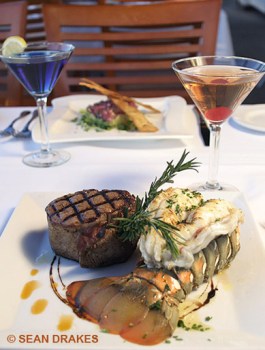
Petit Filet with Lobster Tail.
DINE: The unobstructed 360-degree penthouse view from Windows is as luscious as the Petit Filet with Australian Lobster Tail or Bone in Rib Eye, both specialties of this steak house and martini bar situated near Staples Center.
CHILL: After lunch Johnson designs a relaxing afternoon in West Hollywood by perusing “spiritual, meditation and New Age releases” at Bodhi Tree Bookstore before drifting to Elixr for a mind-clearing herbal tonic. Here a tranquil garden offers “a place to sit and read.”
ENJOY: Downtown’s cultural jewel, Walt Disney Concert Hall, offers self-guided audio tours of this spectacular structure and year-round performances by touring choirs and orchestras. Catch a free exhibit at California African American Museum, which preserves the legacy of African American culture in the western states.
© SEAN DRAKES
Previously published.
[ 404.654.0859 | seandrakesphoto@gmail.com ]
Related articles
15 Minutes: Chef Franco Savors Argentina
Fernando Franco’s kitchen preps 400 dishes daily,
Sean Drakes surveys the chef’s table
When you’re the executive chef of a restaurant situated at a premier address for conferences and international business travelers, expectations are high and distinction is everything.
Fernando Franco has been at the helm of Waterfront Restaurant since its January 2008 opening at Hyatt Regency Trinidad. The native of Buenos Aires, Argentina has worked for Hyatt since 2001. “I think it was a very good idea,” shares Franco, 43, “to open a hotel is like to have a baby, you see the baby from when it’s born. To be here from inception was very exciting.” Franco has created inventive courses at hotels in Europe, Spain and Portugal. His culinary career was launched in 1989 at Alvear Palace Hotel in Argentina where he was a chef de partie. He also served as chef at the US Embassy in Argentina.
Trinidad experienced a restaurant boom in the last decade. The capital city’s allure to the international business sector was heightened after Hyatt catered to President Barack Obama at the Fifth Summit of the Americas in 2009. Franco reinvents menus every three or four months with innovative pairings and approaches using local ingredients. He turned down his pots for 15 minutes to celebrate an Argentinian passion for beef.
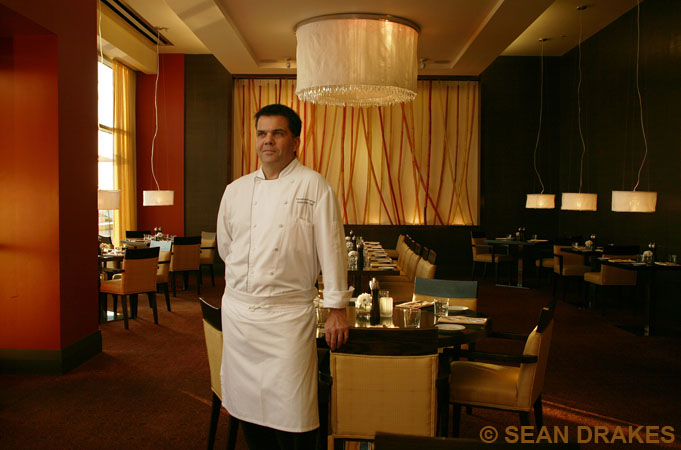
Executive Chef Fernando Franco at Waterfront. Photo: SeanDrakes.com
Franco’s approach to fusing culinary traditions of two cultures onto one menu:
“When I make menus it’s funny,” begins Franco, “with the chef you know all the different ingredients…the produce, you know the taste you know the flavors, and when we talk about new menus and we invent new dishes you mix together ingredients, but you think in terms of flavor. The lamb is good with this herb and this carrot, and then you put the mash, because you know the different flavors and combinations, you don’t need to try the dish. You know when it’s good and it’s not good; take a carrot sauce and you put a sausage with too much herb it’s not that good a combination.”
Franco observes the divergent food habits of three cultures:
Upon arriving in Trinidad his first task was to scour local cookbooks to acquire a primer on indigenous ingredients. Chadon beni, bhagi. dasheen bush, curry and coconut milk are the ingredients that are now fixtures in his culinary arsenal. “The big difference between [Trinidad and Argentina] is breakfast,” suggests Franco, “here you have the doubles, it’s spicy and fried, in Argentina it’s just bread or croissant and coffee, nothing else. It’s not like in the States, they eat eggs, bacon, sausage.”

Sun-dried tomatoes herbed risotto with seared sea bass and fresh organic arugala lettuce. Right: Roasted lamb loin, sweet pumpkin "coo coo" with organic cherry tomato and a merlot reduction. Photos: SeanDrakes.com
Franco factors in geography and creating an experience to feed meat lovers:
“It’s different here than in Italy, France, Miami or Buenos Aires, we have different kind of guest in each place,” he notes. “In Trinidad we have plenty products. You put on a list all the products you can find here, then start doing the combinations,” explains Franco in his slightly patchy English. To construct menus he considers: “If I use white fish and salmon [on a current menu], I find another fish, like sea bass and snapper [for a new menu]. If I used before lamb chops and now lamb legs, next menu I use lamb shank.” Hyatt Regency Trinidad recently unveiled themed dining nights with Argentinian feast for meat lovers on the first Wednesday of each month.
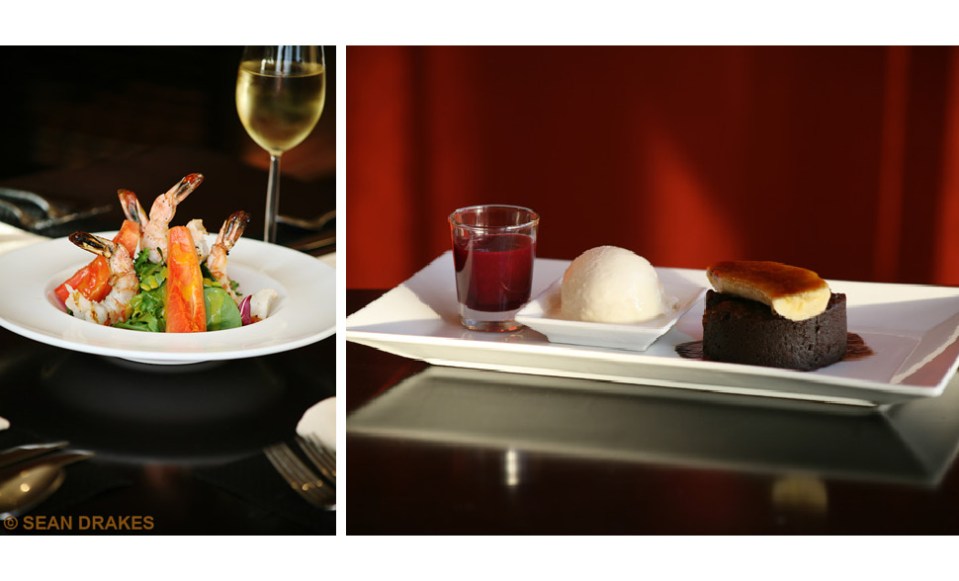
Shrimp and papaya salad served with organic mixed greens with a lime vinaigrette. Right: Dessert trio of steamed chocolate and banana pudding with caramel sauce and vanilla gelato. Photos: SeanDrakes.com
Franco embraces culinary traditions that preserve the bond to his homeland:
“My father cooked on holidays, weekends, special days,” recalls Franco, “all the family worked together in the kitchen.” Franco apprenticed with Francis Mallman and El Gato Dumas, who are credited with launching a culinary revolution in the ’80s that converted aspiring engineers into celebrated chefs, and spawned a slew of culinary institutes in Argentina.
“We are famous in Argentina for beef,” claims Franco, “the rib eye is one of the best cuts now, the strip loins is very good. In Argentina parrillas (bistro-style eateries) serve every cut of beef. On Argentina Night we have the parrilla on two large outdoor grills, we grill beef, lamb, pork, sausage.” Another new fine dining attraction at Waterfront is Brazilian Night. The black bean-based feijoda, explains Franco, is a traditional Brazilian dish served for lunch on Saturdays. For feijoda, most items on the menu are cooked with black beans. Once cooked, the beans are extracted from a black liquid which is separated into six to eight pots and used as stock to cook sausage, bacon, dried meat…all the different parts of the pork.
Franco spends 12-hours each day in a kitchen with his staff of 55. Though he finds time to visit Maracas Beach for a shark ’n bake treat, Franco’s charge to be a creative leader at Waterfront Restaurant keeps his plate full.
© SEAN DRAKES
[ 404.654.0859 | SEANDRAKESPHOTO@gmail.com ]
Short Stay: Casa de Campo
Casa de Campo is an extraordinary island outpost,
Sean Drakes samples the beautiful life
If I try to picture what a replica of a 16th century Mediterranean village situated on a coastal bluff in the Dominican Republic would feel like, I couldn’t have visualized Altos de Chavon in Casa de Campo. This ultra-exclusive resort and residential community is a Caribbean destination that is part 16th century, part 21st century and passionately devoted to the arts.
The levels of luxury accommodations here aim not to be outdone. After all, some of the richest business tycoons own palatial homes here, and both a famous Bill [Gates] and an infamous Bill [Clinton], along with a host of Hollywood highbrows, have deplaned in the private airport here. Name-dropping isn’t part of the accepted local culture, if you want to feel welcomed. I learned this from Angel, the resort agent I befriended and who personally arranged my VIP access. My tour of this 7,000-acre sprawl in La Romana, which is 130 miles southeast of Santo Domingo, starts in the 16th century.

Altos de Chavon at Casa de Campo. Photo: SeanDrakes.com
Altos de Chavon is a replica of a traditional Mediterranean village, it was built on the highest point overlooking the Chavon River. Construction of the coral block and terracotta buildings that frame narrow cobblestone walkways, began in 1976 under the stewardship of Italian artist Roberto Copa. The final stone was laid in 1982. Walking the site at midday feels like a Hollywood set for a movie involving a romantic tryst in Europe. You can dine at bistros or three specialty restaurants: El Sombrero, La Piazzetta and Café del Sol.  The site houses a 5,000-seat Grecian-style amphitheatre that has hosted Dizzy Gillespie, Gloria Estefan, Julio Iglesias, Alicia Keys’ music video shoot and the Dance Theatre of Harlem. There is a Regional Museum of Archeology that is home to a collection of pre-Columbian ritual artifacts. And an art gallery and craft ateliers that make ceramic and silk-screened souvenirs, and The Altos de Chavon School of Design caps the effort to market Casa de Campo as an arts-friendly destination. You should note: The School of Design offers degrees in design fields and the fine arts, and is affiliated with Parsons School of Design in New York and Paris.
 The Dominican Republic, is the Spanish-speaking territory of the island of Hispaniola, a border with a treacherous history separates it from Haiti. Puerto Rico is just 60 minutes east by plane. In order to deliver me to the resort’s doorstep, my driver surrendered his license at a security stall that has the span and scale of an interstate toll booth. That was the first cue to the grandeur that is a staple at Casa de Campo.
I am in a chic suite, but Casa de Campo resort offers the option to supersize your accommodation with a rental villa tastefully lathered with luxury. Exclusive and Oceanfront Villas host up to 12 guests at roughly $840–$2,445 per night ($577–$1,345 off-season), that includes maid and butler service, breakfast prepared in your villa, a pool or whirlpool, and concierge service for sporting and dining reservations, and private airport transfers.
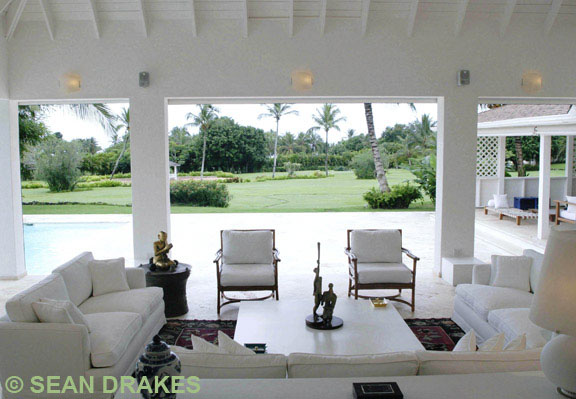
Private residence at Casa de Campo. Photo: SeanDrakes.com
I won’t name-drop, but I have the good fortune and pleasure of photographing two gorgeous private residences during this visit. Both homes reside on an 18-hole golf course. There are three here, each designed by Pete Dye: Teeth of the Dog has seven holes skirting the ocean and is ranked #17 on Golf Digest’s list of top 100 courses in the world. Links is a hilly inland course with five holes that tangle with lagoons and lakes. The Dye Fore course is positioned 300-feet atop the bluffs of the Chavon River, it is a mesmerizing masterpiece. Its 7,800-yard par 72 layout attracts and challenges pro golfers who shell-out $90 – $215 per person per round.
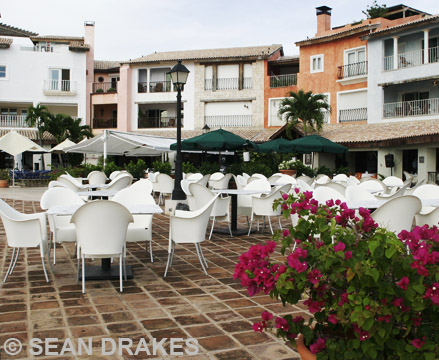
Marina at Casa de Campo. Photo: SeanDrakes.com
I grabbed lunch at Chinois at the marina fashioned after Italian portofinos. I am passing on shopping at designer boutiques, shooting sporting clays and playing tennis (there are 13 courts). My visit is out of season for the polo matches hosted
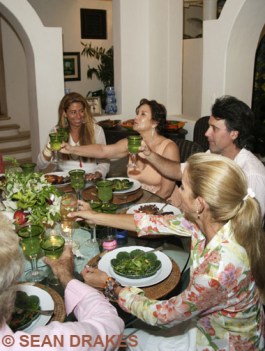
Cuban artist Bibi Leon (2nd from right at top) toasts guests at her home. Photo: SeanDrakes.com
November – May at the equestrian facility, which has five fields and 70 trained ponies. Instead, I’m bound for a day trip sail to Catalina Island.
After sailing, a dinner party at the home of Cuban artist Bibi Leon is a great wrap to the day. Walking through her elegant front door, my feast begins. My eyes are restless, in every room, there’s original creative expression by Spanish artists to admire. Tomorrow, I will ride Bibi’s coattail as we soak in the decadent interior design of her friends’ vacation homes, a collective that can fill two coffee table books. This is la dolce vita, where the air always feels rare.
© SEAN DRAKES
Previously published.
[ 404.654.0859 | SEANDRAKESPHOTO@gmail.com ]
Related articles
15 Minutes: Meiling on Mentoring Anya
Tonight, when Heidi, Tim, Nina and Michael unveil another layer of their process to transform an unknown designer into a brand name, many viewers expect a challenge involving stilt walkers will be a cinch for Caribbean contender Anya Ayoung-Chee.
The skyscraping stilt walker, which originates from West Africa, is a traditional character known as the Moko Jumbie in Trinidad’s Carnival. Odds are in favor that Anya’s vision for styling that silhouette will knock it out the ballpark. Among those with high confidence is Meiling, the women’s wear designer who groomed Anya for her shot on Project Runway season 9.
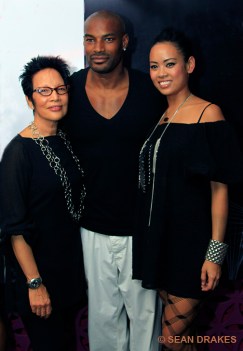
Meiling, Tyson Beckford, Anya Ayoung-Chee. Photo: SeanDrakes.com.
From her charming Gingerbread house on Carlos Street, in Trinidad’s capital city, Meiling offered 15-minutes to reflect on mentoring Project Runway contestant Anya Ayoung-Chee:
How and when did your mentorship of Anya begin?
“I’ve known Anya even before she was born, since her mother has been a close friend and loyal customer for many years. Anya is like a daughter to me and nothing pleased me more when I saw her interest in fashion. When she returned from studying graphic design at Parsons in New York, she gravitated to a natural passion for fashion and her second home became my atelier. She has been privy to my creative design process and she has always been open to advice and guidance.”
A fashion design apprentice should possess the mix of what personality traits and skills?
“It has often been said that to succeed in anything, you need one-third talent, one-third skill and one-third discipline. The most successful interns I’ve had are the ones who are open to embracing new experiences as an opportunity to learn and grow. Whether they are asked to sew a hundred flowers on a dress, assist in a model photo shoot or attend a fitting, they must do it all in a spirit of enthusiasm and readiness. The ones who think they are ‘above’ sorting out a box of buttons or feel they are better than the seamstresses, quickly fall by the wayside.”
Did Anya resist your advice to learn to sew or is it something emerging designers can work around?
“Anya is a very talented designer but as she admitted, her one weakness was the lack of technical experience in sewing. I stress experience, not skill because as a designer she would still be able to recognize quality workmanship and be able to hire staff to create her designs. However, not knowing how a garment is constructed or understanding the jargon in the industry in order to get her ideas across to a seamstress would be a handicap. All the great designers, such as Alexander McQueen, were also great couturiers in their own right.”
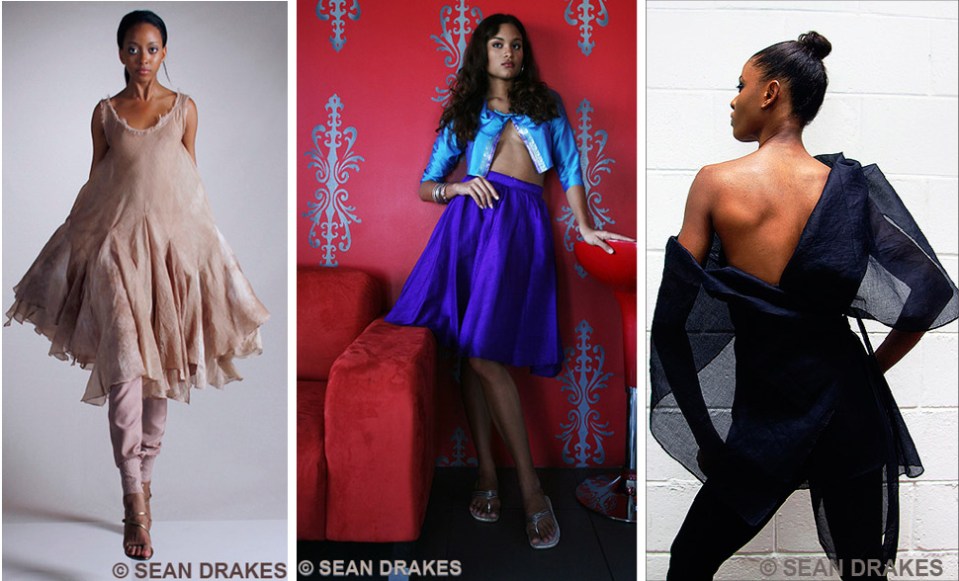
Recent collections by Meiling. Photos: SeanDrakes.com
What’s the likely domino effect from Anya’s participation on Project Runway?
“I would hope, firstly, that PR would open many doors for Anya and people would see what an incredibly talented Trinidadian designer she is. Secondly, it can also open up new avenues for other Trinidadian and Caribbean designers since this show will definitely perk up interest in designers of the region. I have been mentoring many young women and men for several years and my door has always been open to up-and-coming designers, photographers, models, stylists and writers in the industry. I welcome the opportunity to work with new applicants since they will be the ones to sustain the industry.”
Describe the common threads that connect your aesthetic and Anya’s?
“I think the common thread with Anya is an understanding that fashion must be relevant to the times. It is important to be aware of current and future influences and to incorporate them into your designs. This has been one of the truths I stress to all my interns. In terms of an aesthetic, I was very proud to behold the top of Anya’s first [Project Runway] outfit which had a surprising T-back. I believe that the rear of an outfit should always be interesting since people see your back just as much as your front. It is one of my signature looks, especially in my wedding dresses. I was thrilled to see when Anya pulled that look out from her years of working in my atelier to shine under such a stressful first challenge.”
MORE ON MEILING:
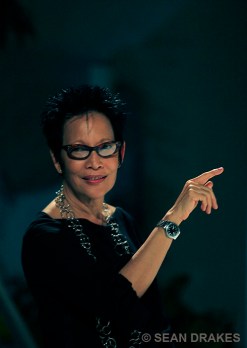
Meiling. Photo: SeanDrakes.com
The Meiling brand has been in existence for over 30 years, the philosophy is simply “less is more”. My trademark designs are deceptively simple looking but with great attention to detail. My customer is a woman who is comfortable in her own skin. She does not need to bare it all to be sexy, and has the confidence to stand out from the crowd in simple elegance. She loves fun, occasional whimsy and does not take herself too seriously. However, she does appreciate and can recognize quality in fabric, cut, fit and workmanship.
© SEAN DRAKES
[ 404.654.0859 | SEANDRAKESPHOTO@gmail.com ]
Related articles
Short Stay: Beyond Bangkok
Road trip across Northeast Thailand
offers wild and mild encounters,
Sean Drakes savors the variety
In the land of fragrant orchids and happy Buddhas, Bangkok is a city of stark contrasts: Humble shacks with sheet metal roofs bookmark concrete-and-glass towers. It is the industrial hub and capital of Thailand, which explains the population of 8 million that’s comprised largely of migratory workers who support the manufacturing of furniture, textiles, electronics and processed foods.
My visit to Bangkok is brief because my goal is to journey off the popular path. The Siam@Siam Design Hotel delivers design swag with straw sculptures, mahogany furniture and varnished concrete, and it’s the launchpad 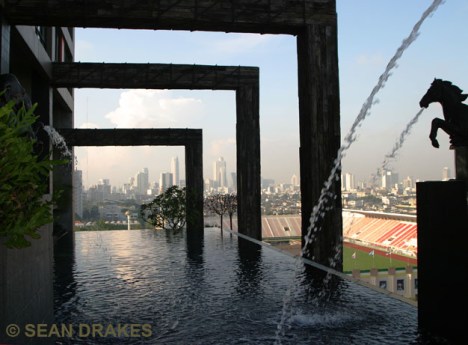 for my road trip across northeast Thailand. It is convenient to public transport, after dark attractions and the Grand Palace–a must-do tour. To align mind, muscles and joints for the adventures ahead I book a 60-minute treatment at S Medical Spa.
Nakhon Ratchasima (or Khorat), the mountainous gateway to the northeast region, is 163 miles from Bangkok and my first destination. Half the fun of a road trip occurs on detours and pit stops. On this first leg, curiosity steers me to taste test strange fruit at Klang Dong, a roadside market with a bounty of durian, betel nut and dragon fruit. Nearby is another intriguing site: Wat Thep Phithak Punnaram. As we approach a snow-white spot on the plush mountainside grows, it’s Luang Pho Yai Buddha, it spans 150-feet by 90-feet and is the largest Buddha in this region.
By lunchtime I’m near Khao Yai National Park and sitting before a plate of stir-fried fillet of ostrich at PB Valley Vineyard. This vineyard embodies Thailand’s vision to produce world-class wine–Japan consumes 25% of its export.  At the first rest camp my senses uncoil then whisper ‘Ooh-la-la’. Kirimaya is a high-end nature resort that specializes in guiltless pampering with affordable luxury. The open-air layout is outfitted with the sort of contemporary Thai design imported by chic lounges in New York and Paris. Attentive staff and majestic surroundings, including a Jack Nicklaus golf course and National Park, assure a heavenly stay.
Seeking a thrill, I drive to The Jungle House and shell-out U$6 to be strapped atop an elephant for a fear-inducing trek through a muddy forest trail and murky river. Half of Thailand’s 7,000 elephants work, the others are wild, according to my guide Yui. Government frowns on locals who bring elephants to urban streets to entertain tourists. To complete an exhilarating day I scour a lively night market for vendors selling flash fried crickets, grasshoppers and beetles. The crunchy critters ar e not bad if you avoid smearing their gooey guts across your tongue.
Back on the road, I roll toward Surin, a province famed for its annual elephant roundup and nearby Ban Tha Sawang silk-weaving village, where I tour the weaving process and buy original souvenirs. A driver and car for a road trip costs 2,500 baht per day (U$50)—not including gas.
My final detour lets me explore the Phimai sanctuary—a Hindu temple conceived in the 16h Buddhist century. Visitors tour its dark chambers and probe sculptures and carvings, and marvel at what this monumental remnant from an early civilization has endured. Ubon Ratchathani, the easternmost Isan province borders Cambodia and is where my extraordinary road trip ends. The Tohsang Khongjiam Resort is set along the serene Mekong River, which churns a gentle serenade at breakfast.
 All week I yearned to get face-to-face with those gentle men in saffron-colored robes. My only sightings were when they scrolled pass my window. On my visit to the Koo-Har-Sa-Wan temple, curiosity drew me to a cliff with a tiled staircase. A gong sounded and lured me down the steps into a spacious room overlooking a valley. On the linoleum-lined floor were eight monks-in-training kneeling before huge, golden statues, as a small group of villagers shared breakfast. They invited me in to join their meal. The road less traveled offers wild and mild encounters, don’t delay to chart your Thai adventure.
© SEAN DRAKES
[ 404.654.0859 | SEANDRAKESPHOTO@gmail.com ]

Short Stay: Knoxville Renaissance
News anchor Tearsa Smith is never
bored in an emerging tech town
By Sean Drakes
“As long as I am in this field my life is never going to be boring,” says Tearsa Smith, a morning and noon news anchor for ABC affiliate WATE–TV 6 News. That sentiment also applies to her adopted hometown of Knoxville, Tennessee. Charming and quaint with a population of about 174,000, Knoxville is noted for its contributions to country music and the 1982 World’s Fair international expo. Among its acclaimed locals are poet Nikki Giovanni and William Henry Hastie, the first African American federal magistrate judge and governor of the U.S. Virgin Islands.

Anchorwoman and city insider Tearsa Smith. Photo: Sean Drakes
Smith points to the new convention center, Turkey Creek shopping district and the $25 million restoration of the Tennessee Theatre as indicators of Knoxville’s diligence to develop. A $2.5 million business incubator at University of Tennessee is one of three high-tech support projects that defines Knoxville’s reputation as Innovation Valley. Originally from Miami, Florida, Smith says Knoxville is a burgeoning media hub with several production companies that support cable TV producer Scripps Networks, which is headquartered in Knoxville and whose presence creates employment for writers, marketing professionals, producers and production crew.
Restaurant chain Ruby Tuesday’s, movie theater chain Regal Cinemas, and processed foods producer Bush Brothers & Co. are also based here. Expansion Management has Knoxville on its 2007 list of 50 Hottest Cities for Expanding Companies. The nearby Oak Ridge National Laboratory, according to Smith, attracts computer science professionals, researchers and engineers to the metro area. But registered nurses, elementary school teachers and auditors outnumber other professions in Knoxville.
“I’m a big shopper, and actually ran the Knoxville Expo 5k/10k,” shares Smith. The Knoxville 100/Casey C. Jones Golf Tournament hosted by 100 Black Men of Greater Knoxville “is a great time for golfers to visit or plan a business trip, tournament proceeds provide “Promise for the Future” scholarships for young men in the mentoring program.” The Knoxville Opera Rossini Festival [has] “an Italian wine tasting hour, it is one of my favorite events that showcases the city’s love of the arts.” The Smoky Mountain Harvest Festival and Women Today Expo are other uniquely Knoxville events, visit City of Knoxville for a full lineup.
_______________________
Tearsa Smith’s City Insights:
STAY: Built in 1799, the Maple Grove Inn 8800 Westland Drive is a Georgian-style house, each of its seven suites is uniquely styled and some have a fireplace. “My favorite room is the Maple Suite,” offers Smith. “Rooms are spacious and don’t feel [like] commercial hotels.”
Four Points by Sheraton Knoxville Cumberland House Hotel 1109 White Avenue is a centrally-located swank, boutique property in the Fort Sanders Historic District. It’s just steps from the Knoxville Convention Center and University of Tennessee.
DINE: It’s tradition at Pasta Trio 119 South Central St. (865) 540-3970 to bring a bottle of wine for your dinner. You sign the empty before adding it to the installation that’s a centerpiece of the decor. Entrées such as the Cajun pasta which Smith says, “is extremely spicy and beyond good,” are mid-range at $20.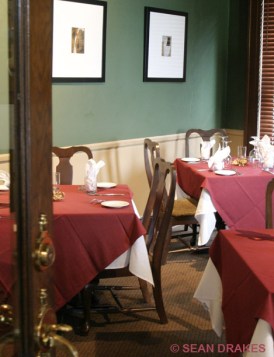
Baker Peter’s Jazz Club 9000 Kingston Pike “is an old mansion converted into a jazz club/restaurant with intimate lighting,” describes Smith. “It’s like eating in someone’s home. The food is consistently good.” Her recommendation: the port wine duck confit with roasted garlic mashed potatoes, sautéed spinach and port wine-blueberry syrup.
SHOP: Bliss Home & Art 24 Market Square (888) 809-2424 is a cozy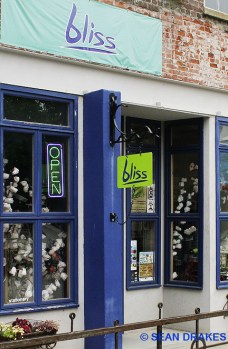 shop trading in vintage home accessories, glassware and novelties. It stands out in Knoxville’s charming Market Square district. “I got a funky wine holder there.”
Knoxville Soap Candle & Gifts 4889 Broadway (865) 689-6545 “is one of my personal favorite [shops], it’s a pamper-me-shop with every type of cream you can imagine, it’s like being at a spa.”
SEE: “I recently went to see the opera Carmen,” at the Tennessee Theatre 604 South Gay Street. “Every time I go there it takes my breath away, the Theatre brings old Hollywood glamor to Knoxville. Bill Cosby, John Legend and Clay Aiken have performed here.
The Comedy Zone 9246 Park West Blvd. “My husband and I double date here quite often. You will leave with a pain in your side from laughter!”
© SEAN DRAKES
Previously published.
[ 404.654.0859 | SEANDRAKESPHOTO@gmail.com ]





 SEAN DRAKES